
The National Park Service (NPS) has issued a Notice of Intent to Prepare a Supplemental Environmental Impact Statement (SEIS) for a Bison Management Plan at Yellowstone National Park (YNP).
The Issue
This NPS Notice to draft new SEIS management alternatives comes on the heels of years’ long attacks on our public lands, wildlife conservation in general and Buffalo conservation in particular on our public lands.
- In June of 2025 the Senate proposed the sale of hundreds of millions of acres of public land. This is the greatest attack on public land among many.
- On January 16th 2026 the Department of Interior revokes American Prairie's Bureau of Land Management grazing permits for Buffalo. This is a Buffalo conservation herd that has been grazing on this public land for 15 years.
- In April the Department of Interior lifted restrictions on hunting in National Parks.
We need your comments to protect YNP's wild Buffalo.
Deadline: May 29th, 2026
Send your Comment:
This is the notice link:
Please log onto the NPS Comment Portal (link below) or send your letters post marked by May 29th to the following.
Electronically:
https://parkplanning.nps.gov/projectHome.cfm?projectId=94496
By Hard Copy, Mail to:
Attn: Bison Management Plan SEIS
P.O. Box 168
Yellowstone National Park, WY 82190
What does all this mean for the wild migratory Buffalo of the Greater Yellowstone?
The Buffalo Field Campaign will be making extensive comment to answer that question. Our Comments will expand on the following:
Buffalo as Wildlife:
The Buffalo of the Greater Yellowstone (GYE) are wildlife and they should be managed as migratory wildlife like all other migratory wildlife of the ecoregion. All new alternatives must have this fact at the center of all new management alternatives. Buffalo are a keystone species whose movement across large landscapes shapes vegetation patterns, soil processes, nutrient cycling, wallowing dynamics, habitat heterogeneity, and ecological connectivity for numerous other species.
The ecological concern is not simply herd size, but herd function and movement across landscapes over generations. If Buffalo are increasingly confined to smaller geographic areas within the Park there is serious risk to overall ecological health including localized and regional land degradation, altered grazing pressure, reduced biodiversity, and cascading ecological impacts throughout the entire GYE. Traditional Ecological Knowledge likewise recognizes Buffalo as a species historically distributed across vast landscapes rather than confined to narrow tolerance zones.
Large Landscapes are to Buffalo Conservation:
The National Park Service should use this Supplemental Environmental Impact Statement (SEIS) process to fundamentally reevaluate the Yellowstone bison management framework and develop alternatives that prioritize large landscape conservation, habitat connectivity, migratory freedom, and the long-term restoration of self-sustaining wild buffalo populations on public lands.
All new alternatives analyzed in the SEIS should include expanded use of large landscapes within the Custer Gallatin National Forest at a minimum. The current management framework continues to rely on artificial tolerance zones and restrictions that prohibit Buffalo from accessing vast areas of suitable National Forest habitat contiguous with Yellowstone National Park. Protecting habitat connectivity and restoring migratory corridors are essential to maintaining ecologically functional and self-sustaining wild Buffalo herds into the future. Millions of acres of adjacent National Forest habitat should be incorporated into long-term management alternatives.
Other resources:
For additional comment content, you may also reference our comments from September 20, 2023 to the Draft EIS. There has been little change in this framework of Buffalo management and these comments from 2023 still hold true.
The record of decision for the current EIS was July 23, 2024. Not even 2 years ago. That brings up a final concern.
Final Concern - Why is a Supplemental EIS suddenly needed:
The current EIS is less than 2 years old. If you are tracking, like we are the current attacks over the past few years on our public lands, wildlife conservation in general and Buffalo conservation in particular on our public lands you may be concerned. BFC is concerned.
The sudden need for a SEIS sets a bad precedent. A Supplemental EIS is extremely rare and nearly unheard of in an EIS that is less than 2 years old. The Supplemental EIS guidance under NEPA considers very few things. However, adverse effects are one of those things.
- i.e. There are substantial new circumstances or information about the significance of adverse effects on the resource (read Buffalo here as the resource).
An anomalous winter weather pattern two winters after a final record of decision of an EIS does not make "substantial changes" Further, the NEPA guidance for a supplemental EIS must show adverse effects to the resource - in this case, Buffalo. This year, the anomalous winter weather had positive effects on Buffalo. They are healthier and happier with plenty of easily available forage. Therefore, we must conclude the forces behind this sudden need for a SEIS want to cause adverse effects to Buffalo rather than alleviate adverse effects - evidenced by the trend of late to adversely impact our public lands, our wildlife, our wildlife conservation efforts and our public trust and national mammal the American Bison.
So, what is the purpose of this SEIS? Is it to stave off or disappear current litigation to the current EIS? Is it to reduce population and/or disappear Buffalo inside the safe haven of the Park boundaries?
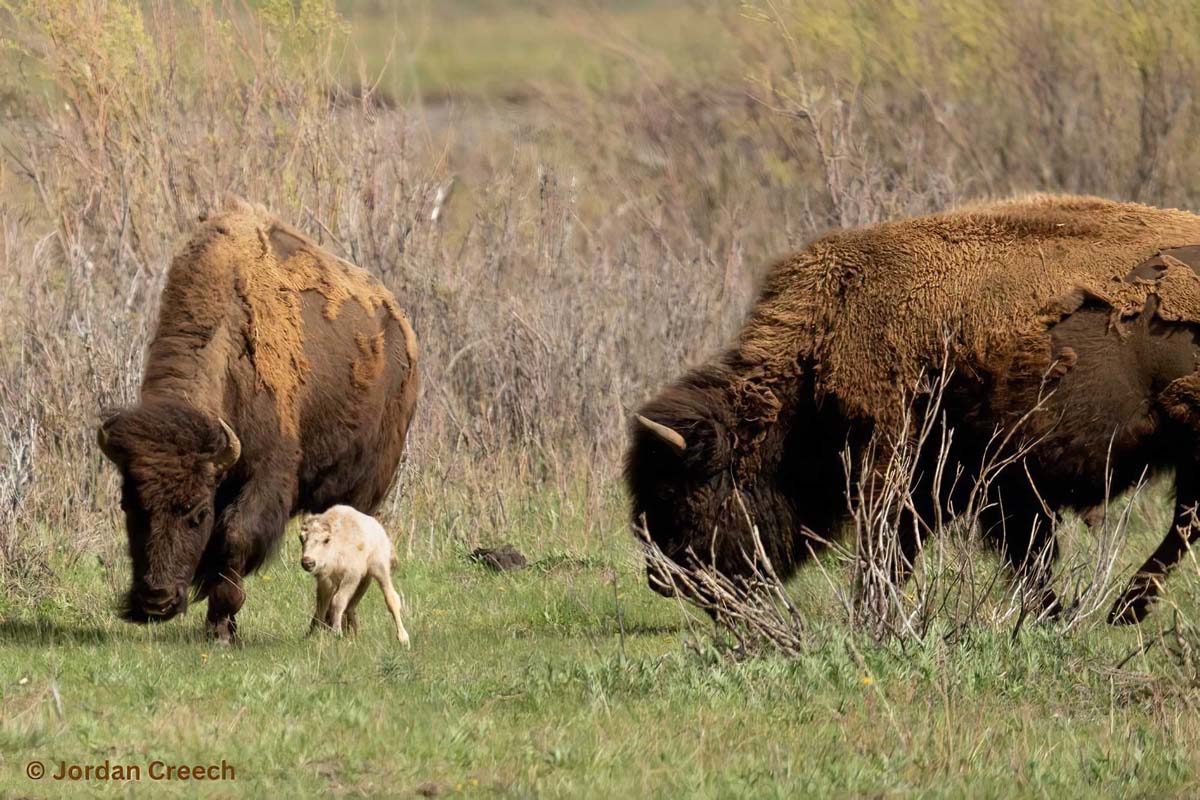 "Mother Earth is the source of life… not a resource.”
Chief Arvol Looking Horse at the White Buffalo Calf Naming Ceremony, June 2024
